Lesson 1.4
Built-up Area
total constructed area tells us much more about how much building we are actually creating.
Now the size of the idea becomes the scale of the construction.
Plot size tells us about land. Total constructed area tells us much more about how much building we are actually creating.
Area changes scale. Design and specification decide how expensive that scale becomes.
01 CHAOS
Now you have several area numbers. Which one describes the construction scale?
By this point, our example contains several useful numbers.
They are not interchangeable.
The missing number describes how much floor area the project is creating across the building.
Built-up area means the approximate constructed floor area across the building's levels unless we specifically say otherwise.
Different documents and authorities may use area terms more specifically. Later lessons can separate carpet area, FAR or FSI area and other definitions where needed.
02 ILLUSION
Plot size alone cannot tell you the scale of the building.
“Both projects are on 1,200 sq ft plots, so they are roughly the same size.”
Not if one builds only the ground floor and the other builds Ground + 2.
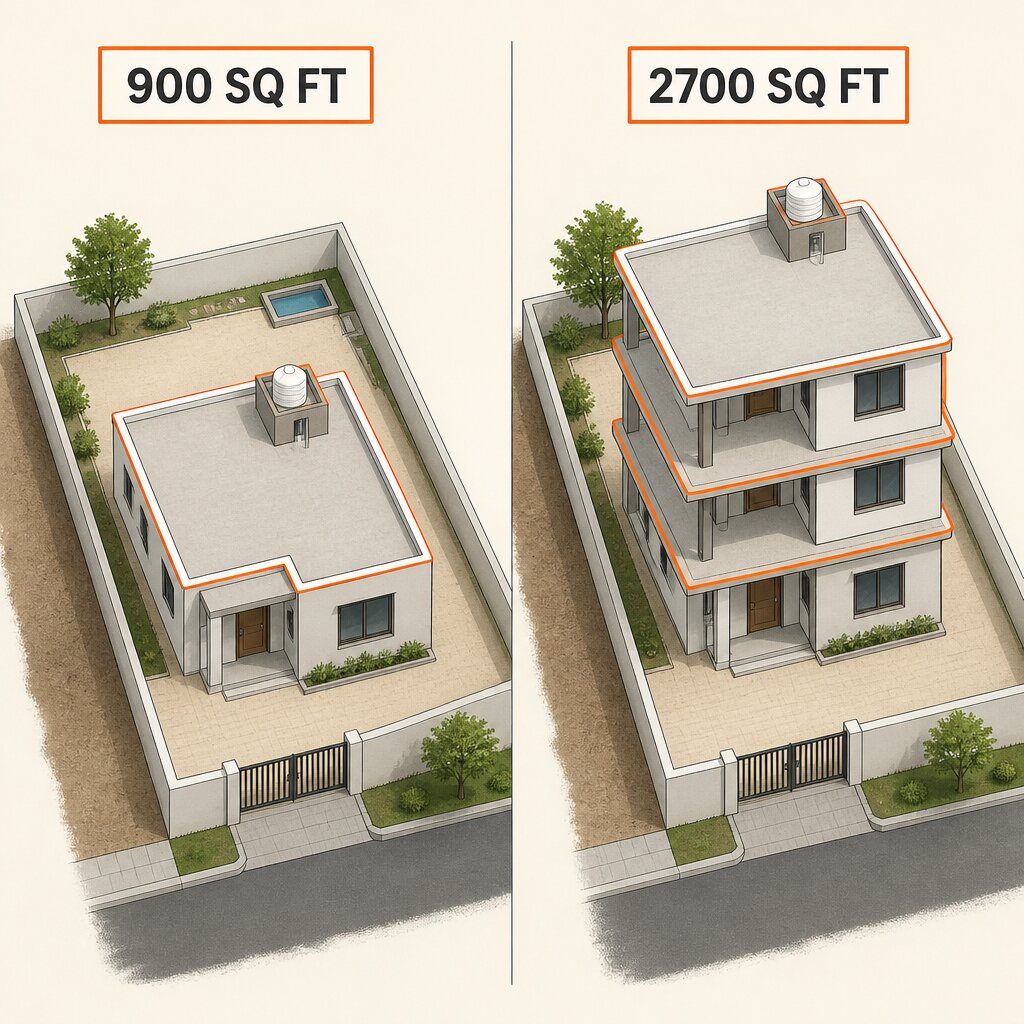
Similar land can support very different amounts of constructed floor area, subject to the actual design and applicable controls.
Project A
Project B
Plot
1,200 sq ft
Working footprint
900 sq ft
Constructed levels
1
3
Working total area
≈ 900 sq ft
≈ 2,700 sq ft
03 SHIFT
Ask how much total building you are actually constructing.
The simplest version is multiplication when the floor plates are approximately the same size.
900 sq ft per floor
2 constructed floors
1,800 sq ft total
How much total floor area am I constructing across all levels?
A simple multiplication works only when the floors are approximately the same size.
When floor plates differ, add them instead.
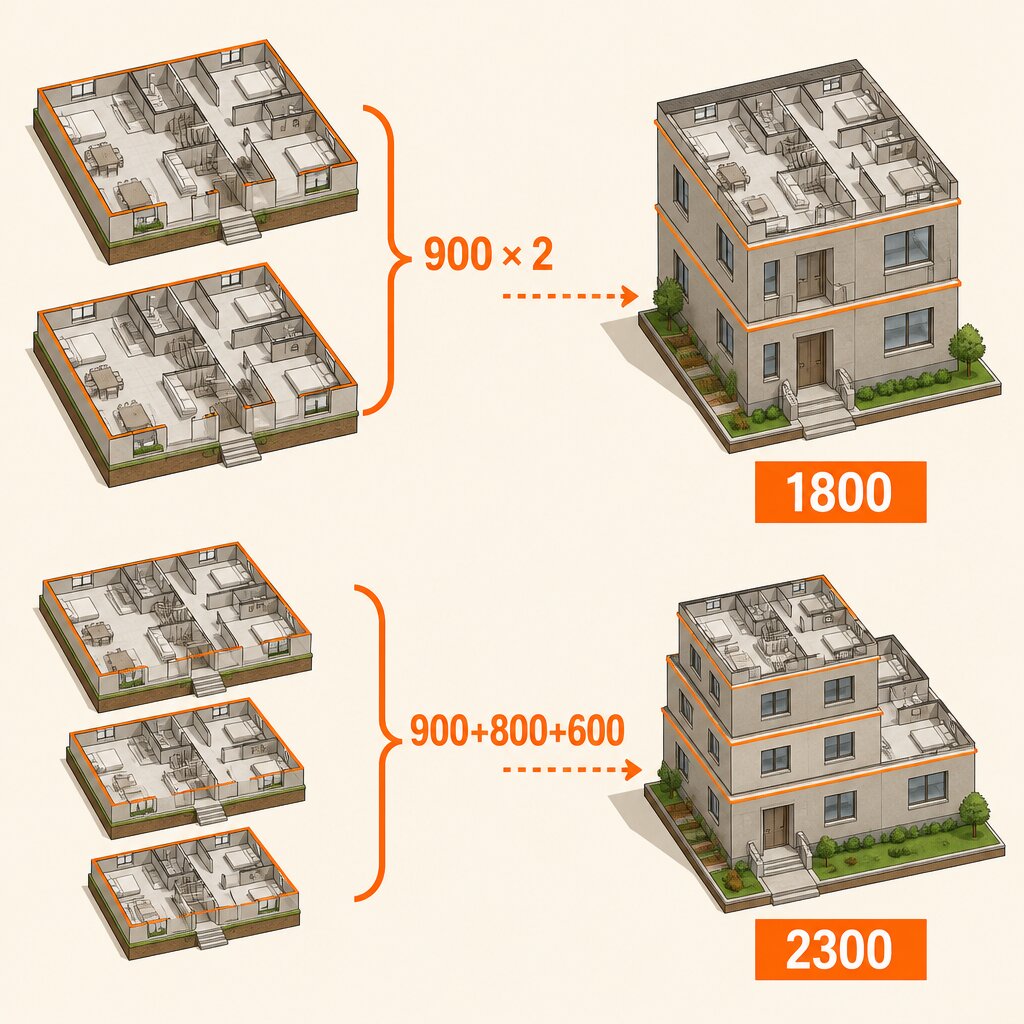
900 Ground
800 First
600 Second
2,300 sq ft
04 SYSTEM
As the building grows, many quantities usually grow with it.
Built-up area is useful because it begins to describe construction scale.
It does not predict every quantity perfectly, and it certainly does not mean double the area always means exactly double the final price.
But a larger building normally creates more work across several systems.
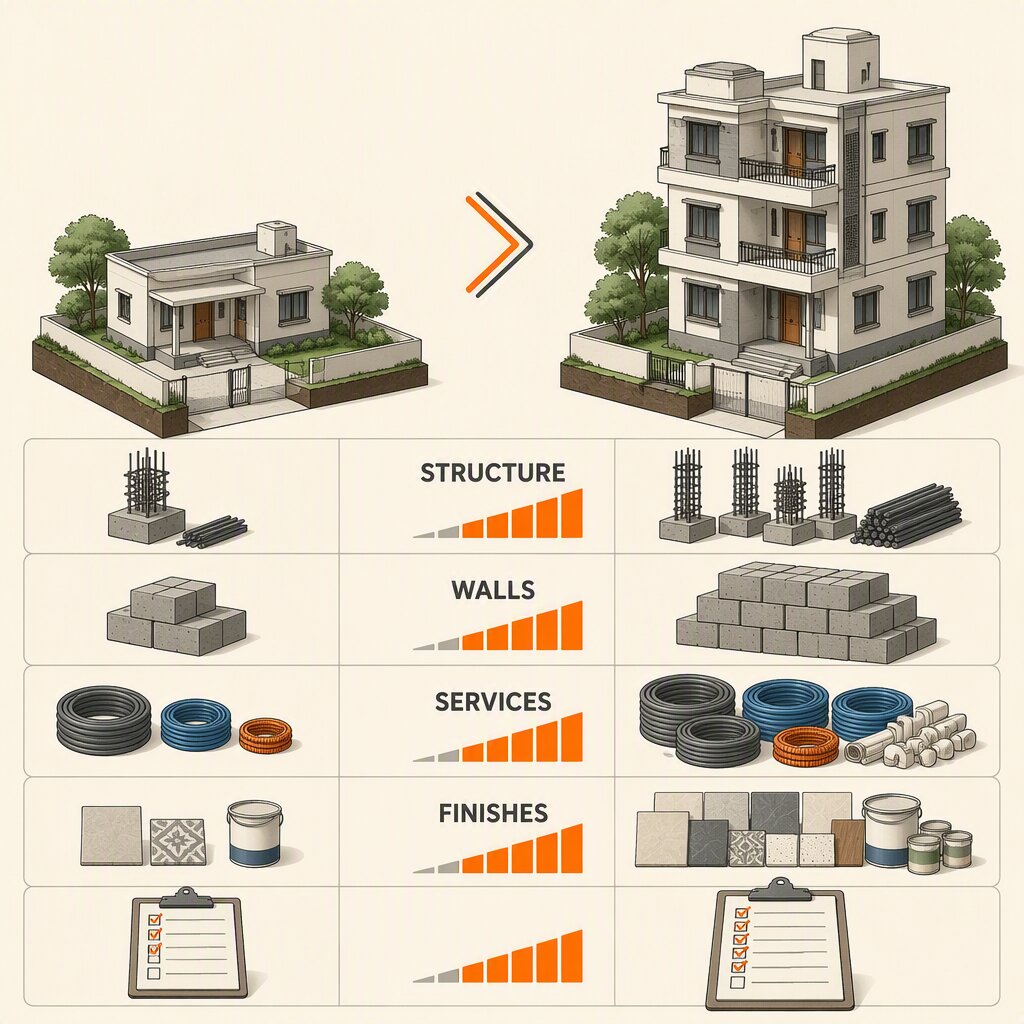
Area changes scale. Layout, specification and complexity shape the final cost.
What usually grows with area
Not an exact price formula| Element | What generally increases |
|---|---|
| Structure | Concrete, reinforcement, formwork and structural labour. |
| Walls | Masonry, plaster and related finishes. |
| Services | Electrical distribution and plumbing work. |
| Finishes | Flooring, paint, tiles, ceilings and fittings. |
| Labour | Total construction work and coordination. |
05 CRAFT
Carry the right area number into every future cost conversation.
From now on, do not let “square feet” stand alone.
Always ask what area the number refers to.
How much land exists.
How much ground the building occupies.
How much constructed floor area the project contains across its levels.
- Do not apply a construction rate blindly to plot area.
- Ask which area definition a quote or estimate uses.
- Do not assume every floor has the same area.
- Remember that wet areas, services and specification can change cost intensity.
- Use built-up area as a scale number, not a perfect price formula.
06 EXERCISE
Calculate the scale, then explain what the number means.
This exercise has two parts.
First, use the relationship between floor area and constructed levels.
Second, show that you understand what the result can and cannot tell you.
Built-up area is a scale number. It is not an exact price by itself.
Build a quick working estimate.
?
What is this result most useful for understanding?
How much land I own
Approximate construction scale
The exact final project price
Use the calculator first.
You now have a number that begins to describe construction scale.
Next, we combine purpose, plot, floors and built-up area into one clear project definition.
Apply the idea
A 900 sq ft floor plate is repeated across 3 levels. What is the built-up area?
Complete the decision to finish this scene.