Lesson 2.9
Underground Water Tank
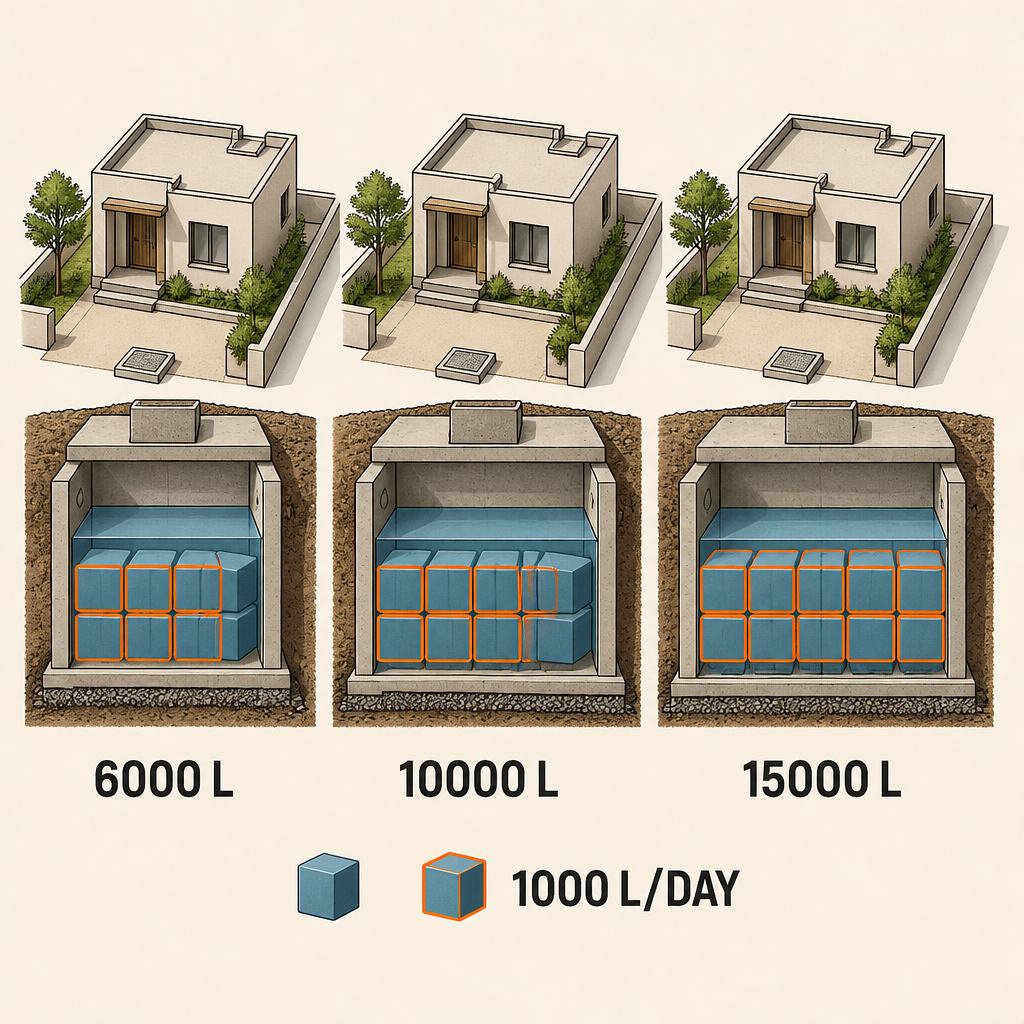
tank size is easier to understand when you convert litres into how many days of water the house can store.
Tank size is easier to understand when you convert litres into how many days of water the house can store.
01 · Start Here
- 6,000 L
- 10,000 L
- 15,000 L
- Backup
02 · The Common Misunderstanding
The biggest tank is not automatically the safest choice. Capacity should match occupancy and how reliable your incoming water supply is.
03 · What the Terms Mean
Smaller storage. Can suit lower occupancy or reliable incoming supply.
Balanced middle capacity for many residential scenarios.
More backup for larger households or less reliable supply.
How much water does the house use per day, and how many backup days do you want?
04 · Compare the Options
6,000 L
Meaning: Lower storage capacity.
Benefit: Takes less underground space.
Know this: Check whether it gives enough backup for your household.
10,000 L
Meaning: Mid-size storage.
Benefit: More buffer without going to the largest tank.
Know this: Still needs a demand-based reason.
15,000 L
Meaning: Large storage.
Benefit: Longer backup or larger household capacity.
Know this: Needs more space, excavation and cleaning volume.
05 · What to Watch
A tank smaller than 6,000 L may still be perfectly suitable for a small household with reliable supply. The warning is choosing capacity without calculating demand. The number alone is not a quality grade.
Ask Before You Approve It
- How many litres per day is the house expected to use?
- How many days of backup are we designing for?
- Where are the inspection cover, overflow and cleaning access?
Check Your Understanding
If your example household uses 1,000 L/day, how many days would a 10,000 L tank cover?
Correct. In this simple example, 10,000 L ÷ 1,000 L/day = 10 days. Real design should use your actual demand.