Lesson 3.1
False Ceilings
false ceilings are one of those things that can spread through a house very quickly.
A false ceiling should have a job.
False ceilings are one of those things that can spread through a house very quickly.
Living room.
Bedrooms.
Passage.
Kitchen.
Sometimes even places where nobody can explain why it is there.
A false ceiling can be extremely useful.
It can hide services.
Organise lighting.
Create cleaner ceiling lines.
Help resolve beams and ducts.
But it also lowers the ceiling and adds another layer that has to be built, finished and maintained.
So before choosing how elaborate it should be, ask a simpler question:
What is this ceiling actually doing?
01 START HERE
Your structural slab is already a ceiling.
Look upward before any interior work begins.
The underside of the RCC slab can itself become the finished ceiling.
A false ceiling creates a second ceiling below it .
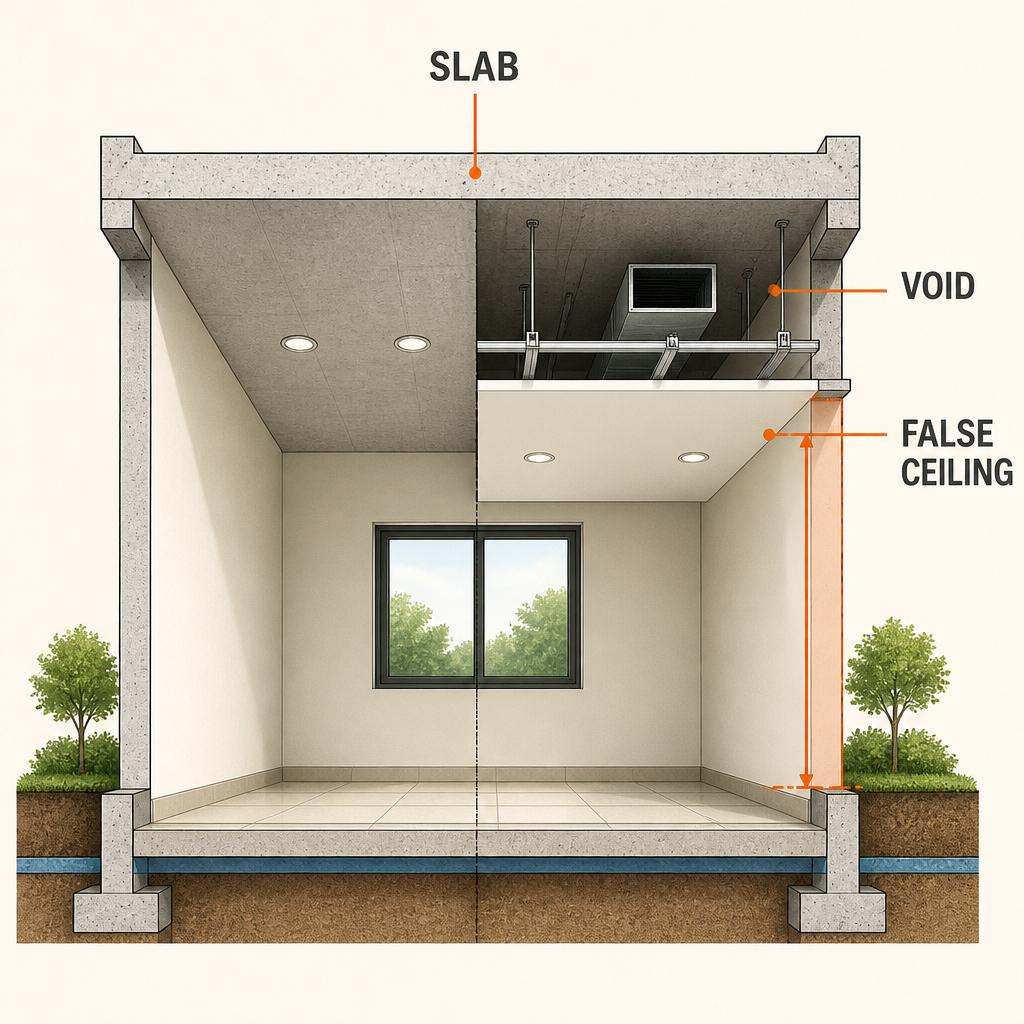
That gap can be used for things such as:
electrical wiring
lighting
AC ducts
curtain pockets
speakers
sprinklers or other services where applicable
So the false ceiling itself is not really the purpose.
The space it creates and the things it allows you to do are the purpose.
02 NO FALSE CEILING
Sometimes the simplest ceiling is the right ceiling.
No False Ceiling
Performance depends on how the choice fits the room, system and workmanship.
Sometimes the simplest ceiling is the right ceiling.
If there are no services that need hiding and the lighting can be resolved cleanly, you may not need a secondary ceiling.
What you gain
- maximum clear height;
- fewer layers;
- simpler construction;
- easier access to the original ceiling;
- lower finishing complexity.
What you give up
You have less room to hide:
- recessed lights;
- cove lighting;
- ducts;
- ceiling services.
That does not make this option inferior.
A carefully finished slab with well-planned surface or pendant lighting can look excellent.
HighlightNo false ceiling does not mean unfinished.
It means the original ceiling is doing the job.
03 POP / GYPSUM FALSE CEILING
Create a clean secondary plane.
POP and gypsum-based ceiling systems are commonly used to create:
- recessed lighting;
- coves;
- cleaner ceiling lines;
- service concealment;
- architectural transitions.
For many homes, this is enough.
You do not necessarily need elaborate shapes.
Often a simple flat ceiling with deliberately positioned lights achieves more than layers of decorative curves.
What matters
The ceiling should be coordinated with:
lights
fans
curtains
wardrobes
window heads
access panels
before it is closed.
04 MORE ELABORATE FALSE CEILINGS
More design gives you more possibilities — and more things to coordinate.
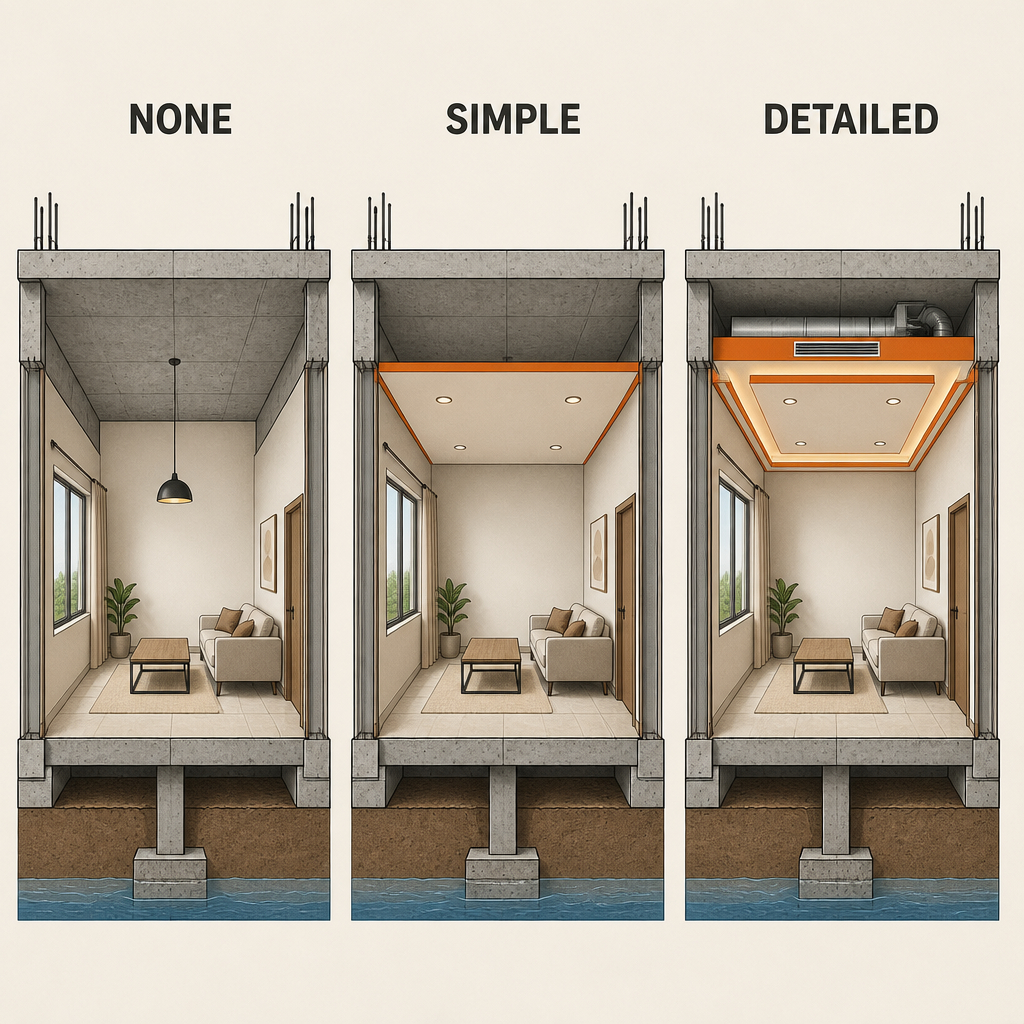
A more detailed ceiling can introduce:
- multiple levels;
- floating planes;
- richer cove lighting;
- concealed tracks;
- profile lighting;
- architectural feature zones.
Used intentionally, this can significantly improve an important room.
But more detailing also means:
- more framing;
- more joints;
- more lighting circuits;
- more finishing;
- more places where cracks or alignment issues may show;
- more coordination.
Key lineMore ceiling design is valuable when the ceiling itself is part of the architecture.
Not simply because more layers look more expensive.
05 DO YOU NEED IT EVERYWHERE?
Where does false ceiling solve something?
This is where the percentage idea becomes useful.
What changes beyond the visible finish?
The construction, coordination, maintenance and use still matter.
This is where the percentage idea becomes useful.
A house does not have to be:
100% false ceiling
or
0% false ceiling.
Maybe the living room benefits.
Maybe the passage needs services concealed.
Maybe bedrooms only need a simple perimeter treatment.
Maybe some rooms need none.
Better mental model
Instead of asking:
“Do I want false ceiling?”
ask:
Where does false ceiling solve something?
That lets the house use it selectively.
07 SYSTEM
System
Function
Fit
Coordination
Maintenance
A false ceiling touches:
Where will fittings sit?
Will blades clear the ceiling design?
Are ducts or indoor units being concealed?
Is there a curtain pocket?
Where does the wardrobe meet the ceiling?
Can concealed equipment still be reached?
One decision:
FALSE CEILING
affects
HEIGHT + LIGHTING + AC + FANS + CURTAINS + JOINERY
08 CRAFT
A good false ceiling hides complexity.
Craft
The useful decision is the one that remains practical after construction is finished.
Before closing the ceiling:
Know exactly how much height is being lost.
Do not randomly cut holes later.
FINALISE FANS
Fan centres should already be known.
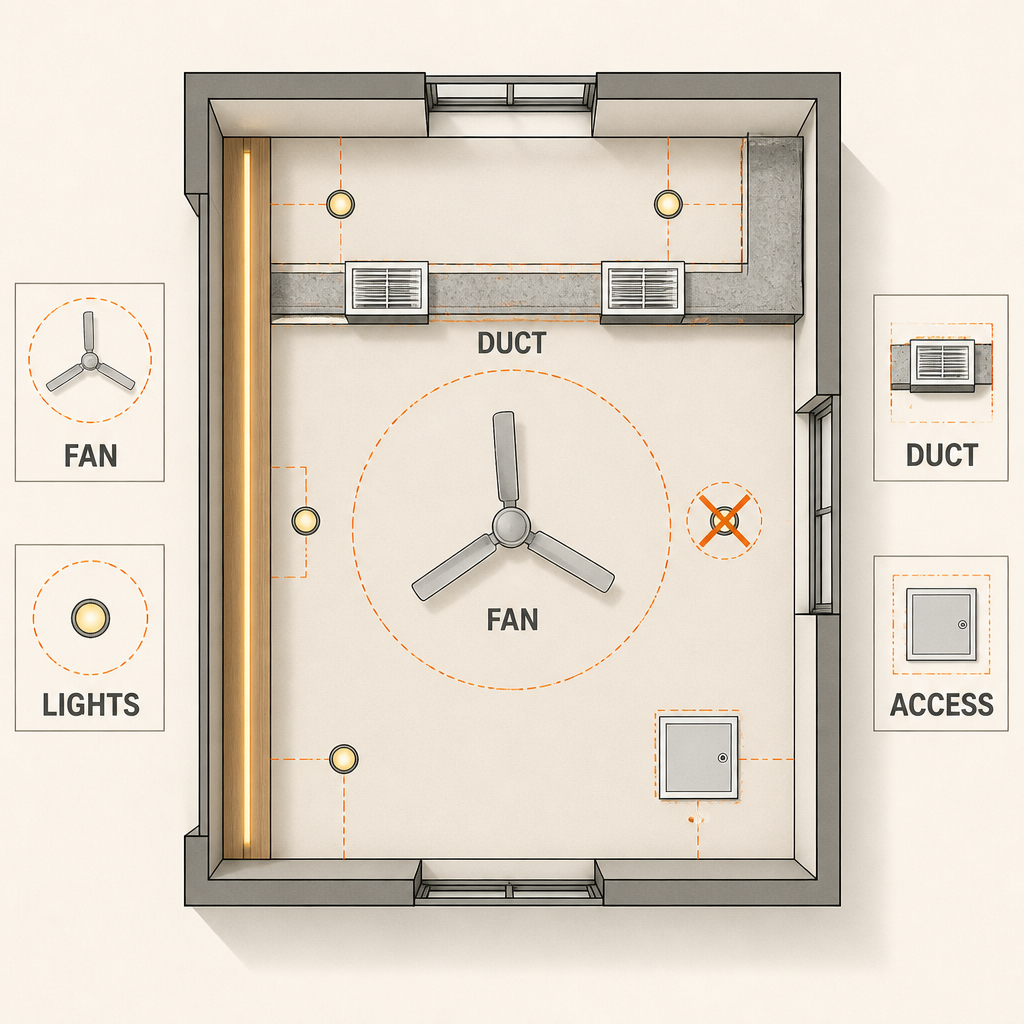
Ducts and access should be planned.
Anything requiring future maintenance needs a way to reach it.
Before everything disappears.
Final highlight
A good false ceiling hides complexity.
It should not create complexity for no reason.
09 CHECK YOUR UNDERSTANDING
Check Your Understanding
The room has good clear height, no AC duct, no concealed services and simple lighting. What is the better decision?
A
B
A false ceiling should have a job.
Apply the idea
Give each ceiling decision a reason.
Complete the decision to finish this scene.