Lesson 3.3
Lighting & Fans
comfort comes from what the room does, not how many fixtures it contains.
Comfort comes from what the room does, not how many fixtures it contains.
Lighting and fans both live on the ceiling.
They also compete for the same ceiling.
A room can have expensive lighting and still feel uncomfortable.
A beautiful fan can still circulate air badly.
So we start with function.
01 LIGHTING IS NOT ONE THING
Different light does different jobs.
Function
Fit
Coordination
Maintenance
Different light does different jobs.
A useful way to understand lighting is through layers.
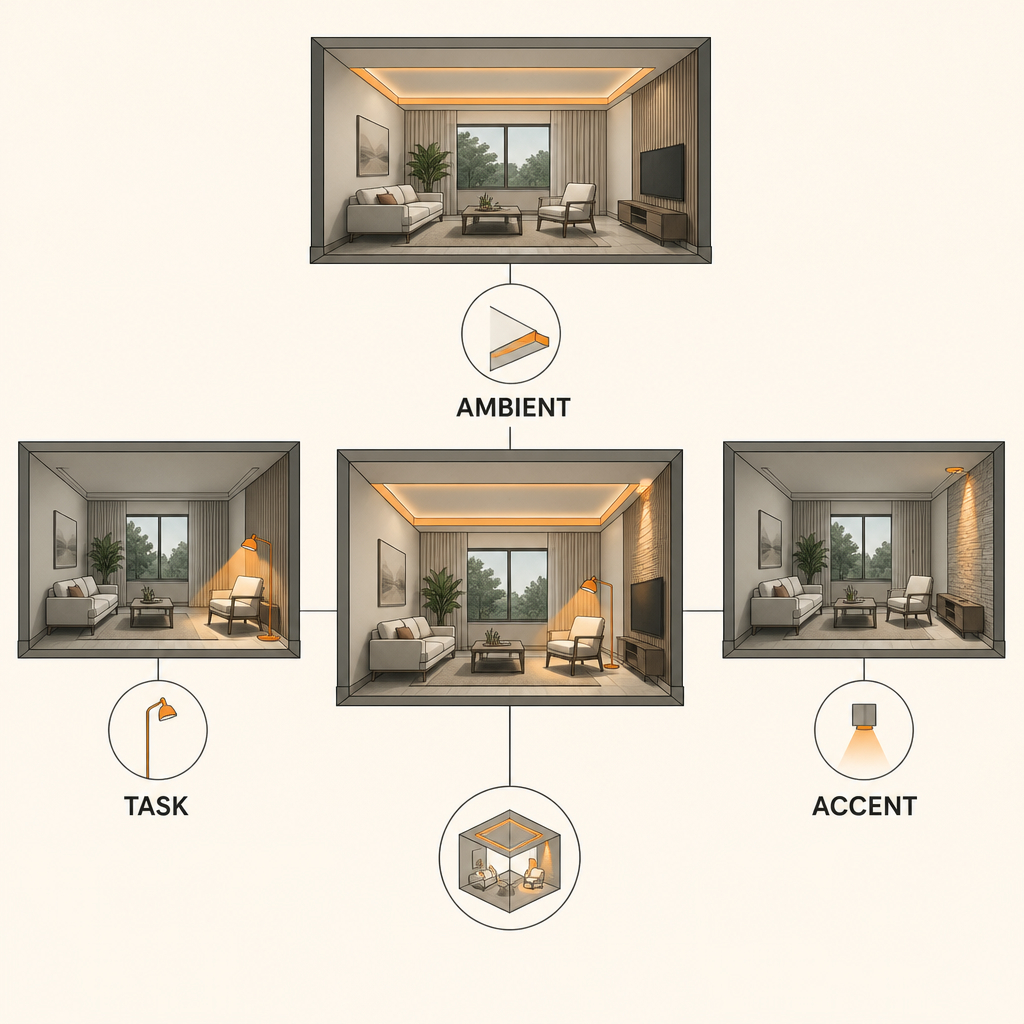
General light that lets you move comfortably through the room.
Light where a specific activity happens.
Examples:
kitchen counter
study desk
bathroom mirror
reading chair
Highlights something.
Artwork.
Wall texture.
Shelf.
Architecture.
The fixture itself contributes visually.
Pendant.
Chandelier.
Feature lamp.
HighlightNot every room needs every layer.
02 STANDARD LIGHTING
Make the room work first.
The upgrade solves a real functional or comfort requirement.
More specification is not automatically more value.
Make the room work first.
A simple lighting scheme can provide:
- clear general visibility;
- appropriate lights where needed;
- straightforward switching;
- easy maintenance.
That can be excellent.
A bedroom does not become bad because it lacks twenty recessed lights.
Sometimes:
one central fan
good ambient light
two bedside lights
does everything the room needs.
04 LUXURY / ARCHITECTURAL LIGHTING
Luxury / Architectural Lighting
At the higher end, lighting can become integrated into the architecture.
Think:
- concealed linear lighting;
- tracks;
- wall washing;
- feature pendants;
- dimming;
- programmed scenes;
- integrated profiles.
This can be extremely effective.
But only if the architecture has been designed for it.
Randomly adding more lighting types often creates visual noise.
05 COLOUR TEMPERATURE
NOW THE FAN
You have probably seen rooms that feel:
What changes beyond the visible finish?
The construction, coordination, maintenance and use still matter.
You have probably seen rooms that feel:
very yellow
or
very white
This partly comes from light colour temperature.
In simple terms:
Feels softer and more relaxed.
Often useful in living and bedroom environments.
Can feel sharper and more clinical.
Can be useful in some task-focused environments.
But lighting design should remain consistent enough that adjacent spaces do not feel accidentally mismatched.
You do not need to memorise numbers yet.
You need to understand that:
brightness and colour are different things.
NOW THE FAN
06 A FAN IS A COMFORT DEVICE FIRST
A Fan Is A Comfort Device First
You may compare fans as:
standard
premium
designer
But the room experiences:
airflow
noise
speed
control
placement
before it experiences styling.
07 STANDARD FAN
Standard Fan
The useful decision is the one that remains practical after construction is finished.
A simple fan can provide:
- reliable airflow;
- familiar control;
- easy replacement;
- good value.
For many rooms, that is exactly what is needed.
09 DESIGNER / LUXURY FAN
A sculpture that happens to rotate is not automatically a good fan.
A fan can also become part of the interior composition.
That can make sense in:
- large living rooms;
- feature spaces;
- double-height rooms;
- carefully designed interiors.
But it still has to move enough air for the space.
HighlightA sculpture that happens to rotate is not automatically a good fan.
10 FAN SIZE & ROOM SIZE
Fan Size & Room Size
Understand the term, then judge the system.
A fan should relate to:
- room dimensions;
- ceiling height;
- furniture;
- number of occupants;
- required airflow.
Bigger is not universally better.
A very large fan in a small room can look awkward.
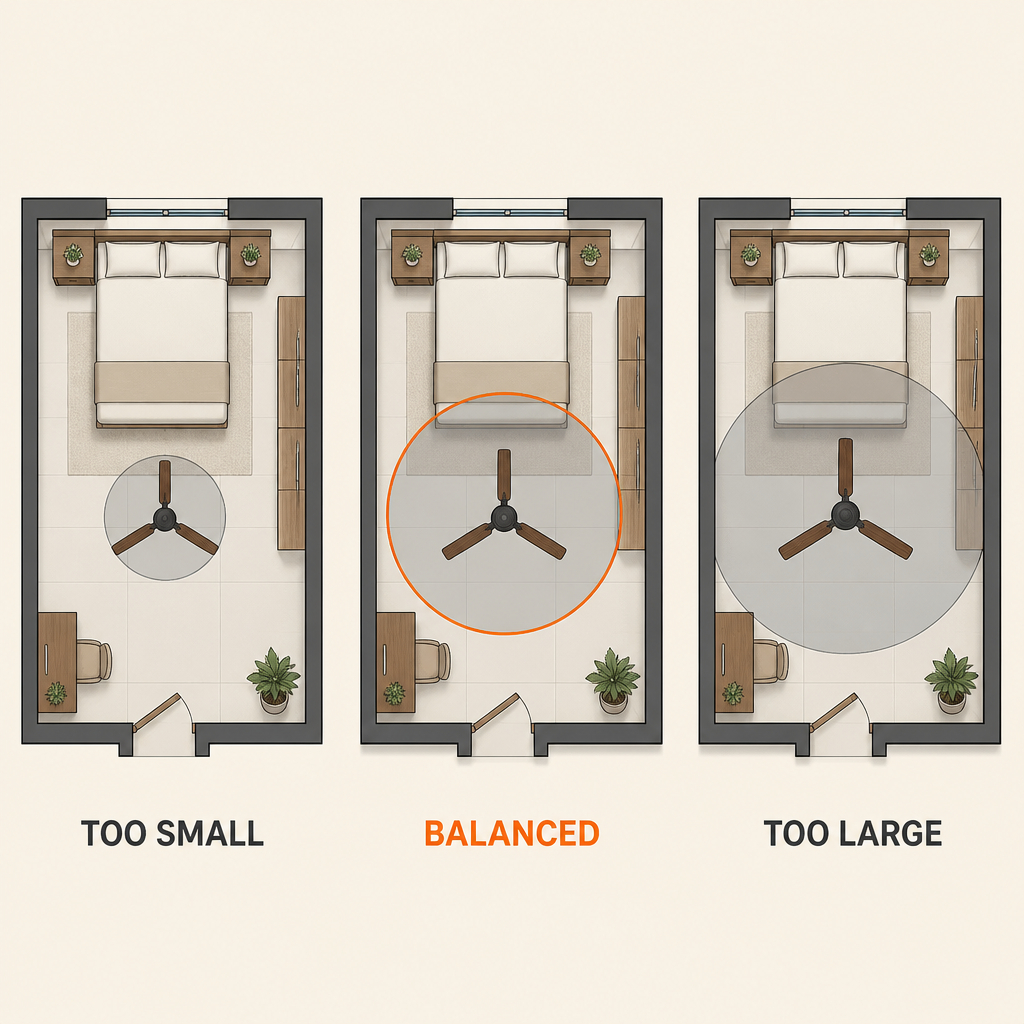
A small fan in a large room may not circulate air adequately.
11 LIGHTS AND FANS MUST SHARE THE CEILING
Lights And Fans Must Share The Ceiling
This sounds simple.
Yet it causes constant conflicts.
Imagine:
Fan blades passing directly below downlights.
Result:
moving shadows / flicker
Or:
A decorative pendant placed where the fan needs to be.
Or:
A fan shifted because a beam was discovered.
Better sequence
Furniture plan
Fan centre
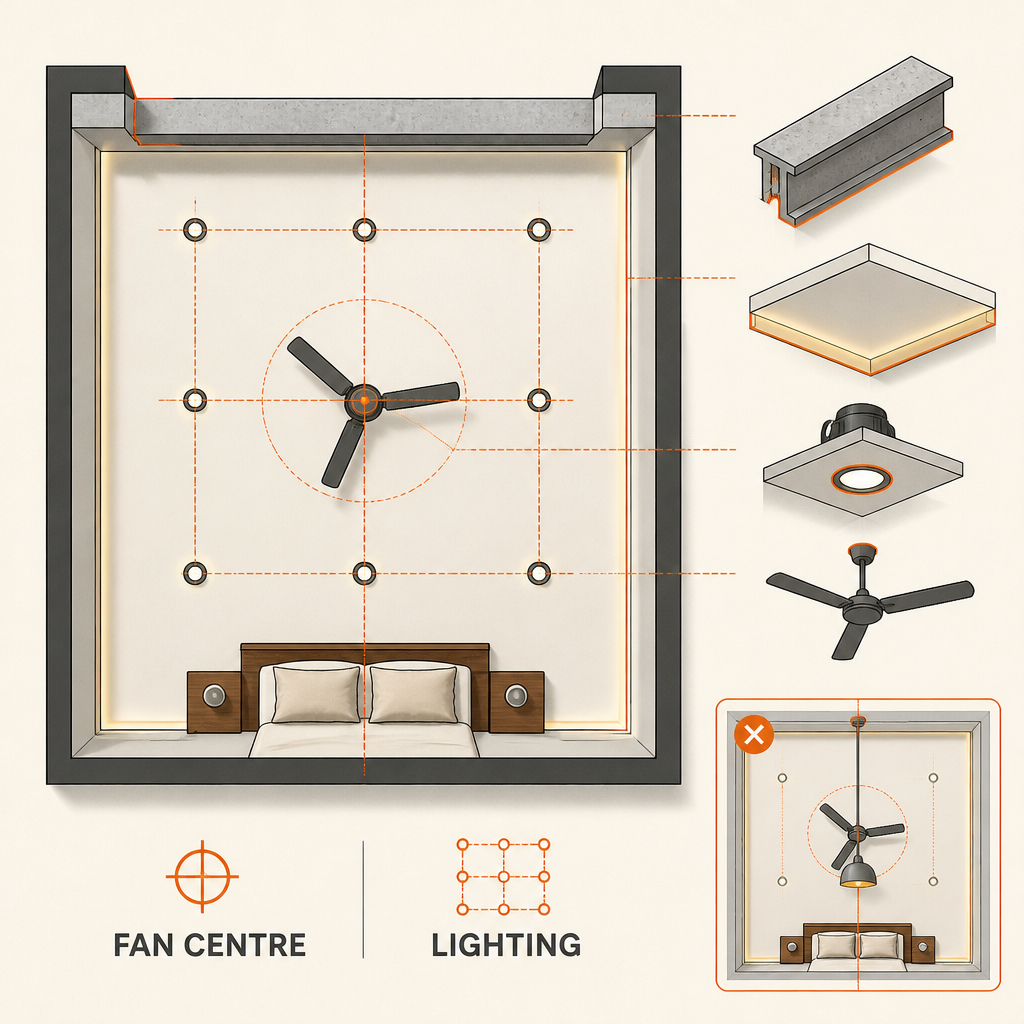
Lighting layout
False ceiling
They should be designed together.
12 CHECK YOUR UNDERSTANDING
Comfort first. Decoration second.
Which fan priority is more useful for a bedroom?
Most decorative
Correct sizing + quiet operation
What should be fixed before placing downlights around the fan?
Fan centre
Wall-paint colour
Comfort first. Decoration second.
Apply the idea
Choose the two first priorities for a comfortable room.
Complete the decision to finish this scene.
Choose exactly 2.