Lesson 5.8
Maintaining Your House
02 monthly / routine observation monthly / routine observation you do not need a formal inspection every month.
Maintain the building, not just its appearance.
Know what was built. Know that it works. Keep the information needed to look after it.
01 The Best Maintenance Tool
The Best Maintenance Tool
Pay attention.
Look for changes.
A new stain.
A strange sound.
A slow drain.
A loose hinge.
A crack that is growing.
An MCB that repeatedly trips.
A pump running longer than usual.
Small signals often arrive before big failures.
02 Monthly / Routine Observation
Monthly / Routine Observation
You do not need a formal inspection every month.
Simply notice:
- leaks
- unusual smells
- drain behaviour
- pump noise
- electrical tripping
- pest activity
- dampness
- hardware becoming loose.
Know what normal looks like.
Then abnormal becomes easier to notice.
03 Drains
Drains
Keep important drains clear.
Especially:
- terrace outlets
- balconies
- utility areas
- external drains.
A perfectly waterproofed terrace can still suffer if water has nowhere to leave.
04 Before The Monsoon
Before The Monsoon
For many Indian homes, this is a very useful annual habit.
Inspect:
Clear debris.
Check flow.
Look for obvious cracks or failed joints.
Check damaged sealant where visible.
Look around pipes and equipment.
Note unexplained damp areas.
Prepare for water before the water arrives.
05 After Heavy Rain
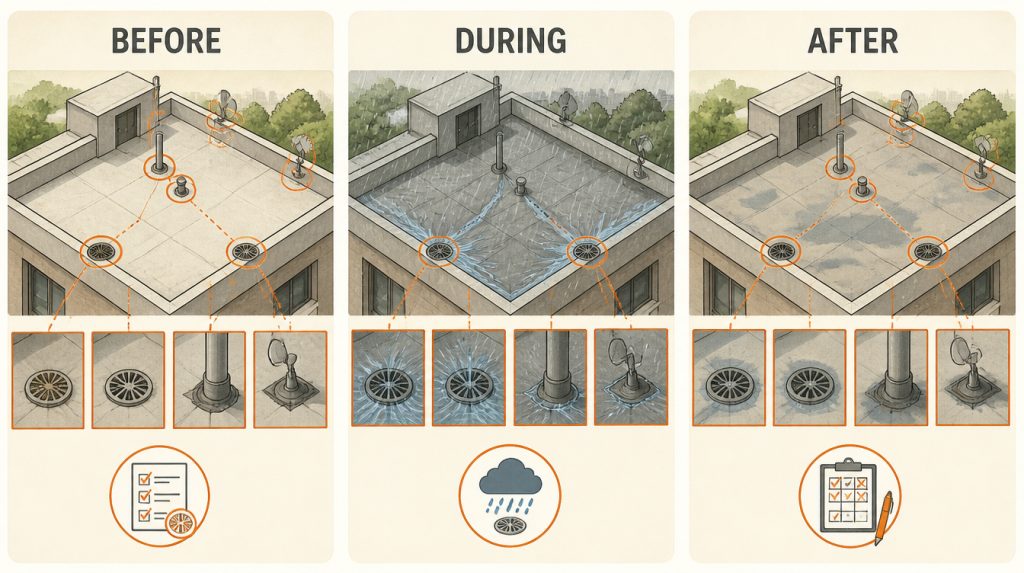
After Heavy Rain
This is one of the best times to understand the house.
Look for:
- damp patches
- terrace ponding
- balcony drainage
- window leakage
- external wall issues.
Problems are easier to diagnose while the conditions causing them are present.
06 Pumps & Water Systems
Pumps & Water Systems
Follow the maintenance recommended for installed equipment.
Pay attention to:
- unusual noise
- frequent cycling
- reduced pressure
- leakage
- controls.
Do not wait for complete failure if behaviour changes significantly.
07 Water Tanks
Water Tanks
Tanks need hygienic maintenance.
Plan for:
- periodic inspection
- cleaning as appropriate
- checking covers
- overflow condition
- pump system.
The exact cleaning schedule can depend on supply quality and local conditions.
The principle is:
Stored water infrastructure also needs maintenance.
08 Ac & Ventilation
Ac & Ventilation
AC systems require periodic service.
Basic care may include:
- filter cleaning
- drain inspection
- professional servicing as required.
Also check that bathroom exhaust systems remain functional.
A dead exhaust fan quietly changes moisture conditions inside a bathroom.
09 Windows & Doors
Windows & Doors
Occasionally inspect:
- locks
- hinges
- rollers
- gaskets
- sealant
- drain channels
- alignment.
Small adjustments can prevent larger wear.
10 Joinery
Joinery
Watch:
- hinges
- drawer channels
- moisture under sink
- loose handles
- swelling
- damaged edges.
Under-sink cabinets deserve particular attention because a tiny plumbing leak can remain unnoticed behind stored items.
11 Exterior Metal
Exterior Metal
Railings.
Gate.
Fabrication.
Look for:
- coating damage
- rust
- loose anchors
- hardware wear.
Treat early corrosion before it spreads.
12 Paint
Paint
Paint eventually needs renewal.
Before repainting:
ask why the old finish failed.
Normal aging?
Fine.
Water?
Fix the water.
Cracking?
Understand the crack.
Never use the new finish to hide an unresolved old problem.
13 Termite Protection
Termite Protection
Where your building has a termite-treatment strategy, preserve its records.
If it includes a system intended for future retreatment, know:
- where access points are
- who services it
- what maintenance/retreatment regime applies.
Do not wait until everyone has forgotten that the system exists.
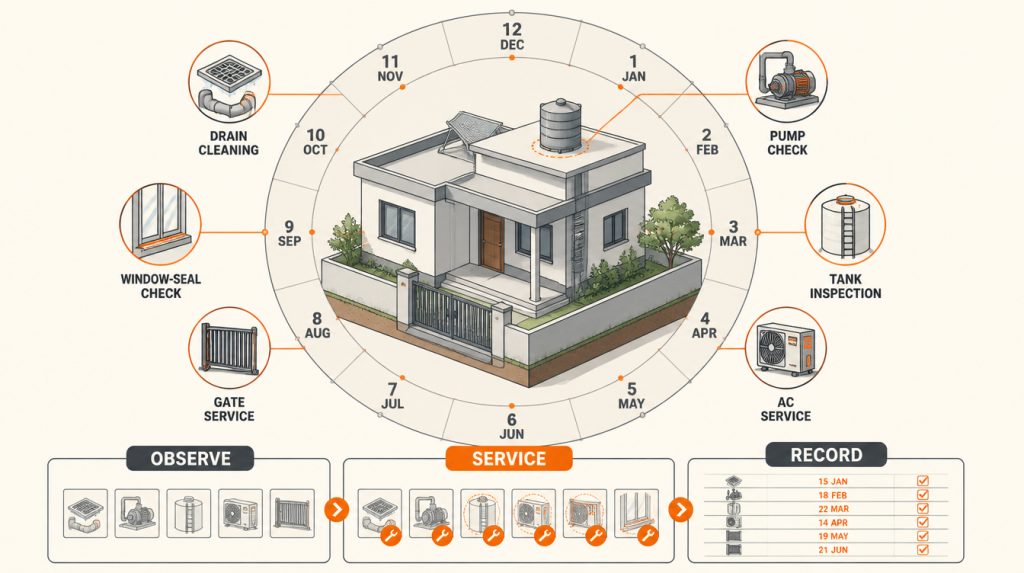
14 Keep A Home Maintenance Log
Keep A Home Maintenance Log
It can be incredibly simple.
House service history
Simple is enough| Date | Area | Work |
|---|---|---|
| Aug 2026 | Terrace | Drains cleaned |
| Sep 2026 | Kitchen | Sink leak repaired |
| Jan 2027 | Gate | Motor serviced |
| Apr 2027 | AC | Annual service |
This becomes the service history of the house.
15 The Final Principle
The Final Principle
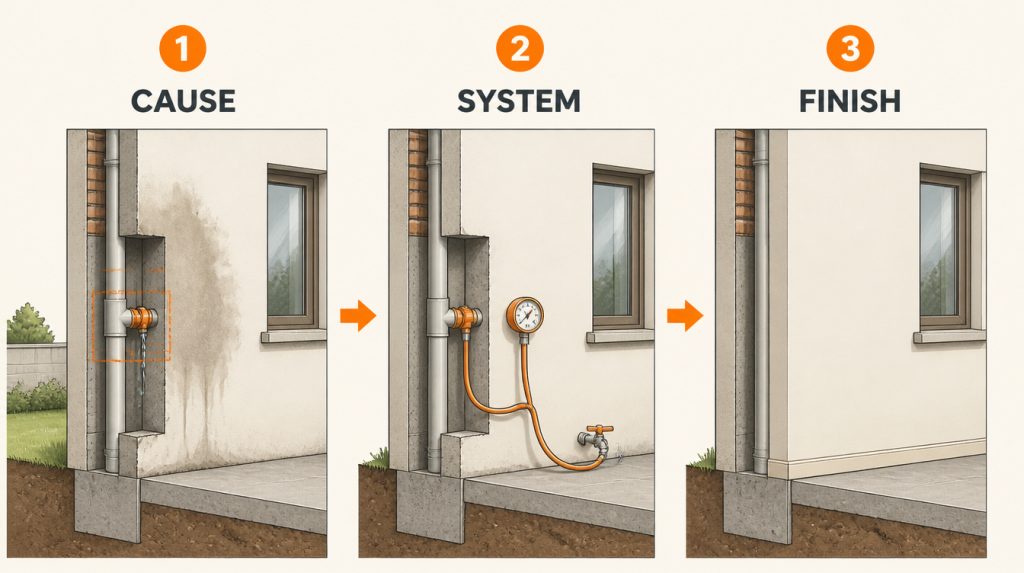
When something fails:
FIRST
Find the cause.
THEN
Repair the system.
LAST
Repair the finish.
Not:
paint
patch
hide
repeat
16 Final Check
Maintain the building, not just its appearance.
A damp patch returns after every monsoon. Select the correct order.
Restore the finish
Find the cause
Repair the system
Maintain the building, not just its appearance.
Ownership begins when the project information, controls and maintenance knowledge become yours.
Apply the idea
Respond to an early warning sign.
Complete the decision to finish this scene.
- Arrange the right inspection or maintenance
- Notice and record the change
- Verify the cause is resolved
- Identify likely source and urgency