Lesson 3.7
Bathroom Planning & Fittings
a luxurious bathroom is not the bathroom with the most things inside it.
A luxurious bathroom is not the bathroom with the most things inside it.
A bathroom has to fit:
people
water
fixtures
movement
storage
drainage
and
maintenance
into a relatively small space.
Adding more fixtures can improve the bathroom.
Or it can simply make the room crowded.
01 START WITH THE BASIC BATHROOM
Three well-planned fixtures beat four badly-planned fixtures.
A typical bathroom might need three fundamental functions:
WC
BASIN
That is already a complete bathroom.
The important thing is whether these three functions are arranged well.
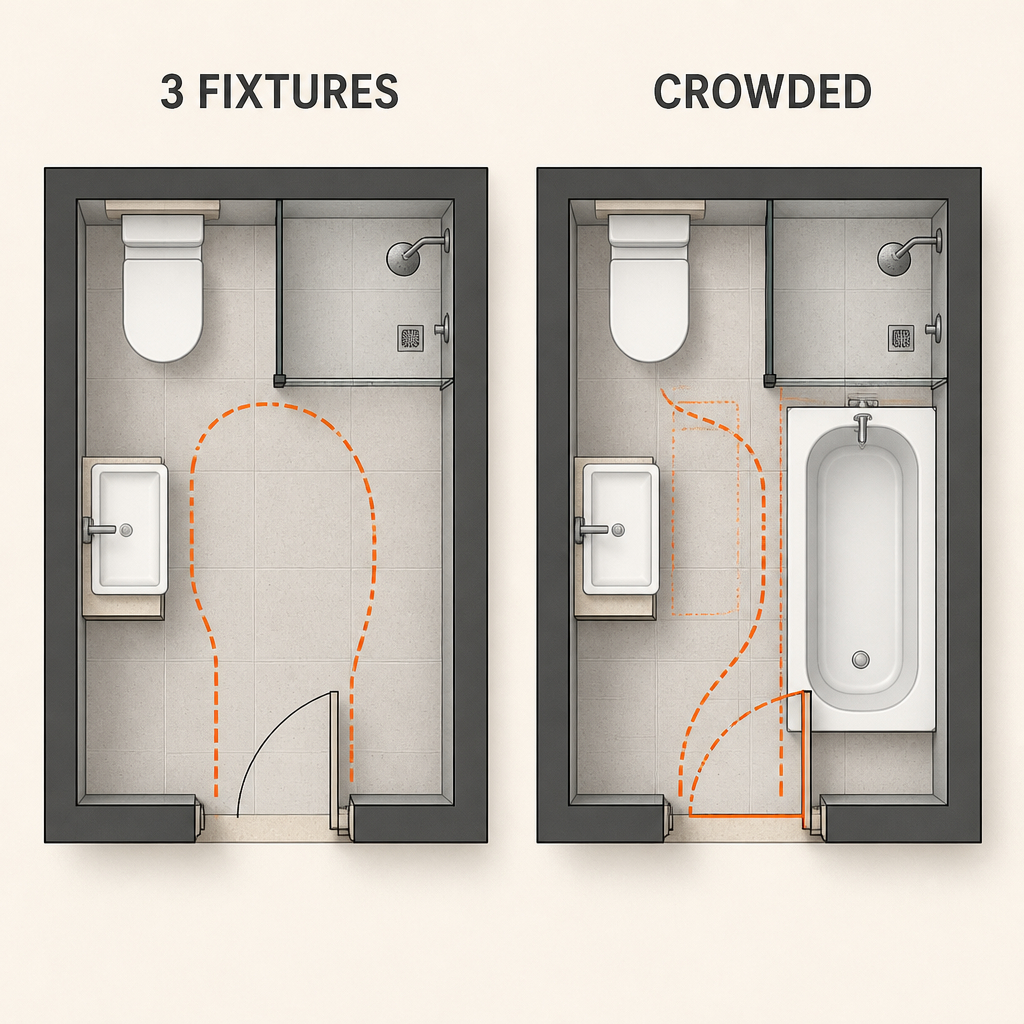
Can you enter comfortably?
Can the shower stay reasonably separated?
Can the door open?
Can you stand at the basin?
Can the WC be used comfortably?
Can the room be cleaned?
HighlightThree well-planned fixtures beat four badly-planned fixtures.
02 THE STANDARD THREE-FIXTURE BATHROOM
The Standard Three-Fixture Bathroom
Function
Fit
Coordination
Maintenance
A compact bathroom can work extremely well with:
- WC;
- wash basin;
- shower.
The quality comes from:
spacing
layout
storage
drainage
lighting
ventilation
not from adding another object.
03 UPGRADE THE MASTER BATHROOM SELECTIVELY
Upgrade The Master Bathroom Selectively
The upgrade solves a real functional or comfort requirement.
More specification is not automatically more value.
Not every bathroom needs to be identical.
Maybe common/secondary bathrooms remain efficient.
The master bathroom receives:
- larger vanity;
- better shower;
- separate wet/dry organisation;
- additional storage;
- better fittings;
- perhaps an additional fixture where space allows.
This is often a much more sensible use of area than enlarging every bathroom equally.
Key lineUpgrade the room that benefits from the upgrade.
04 FOUR-FIXTURE BATHROOM
Four-Fixture Bathroom
A larger bathroom might include something such as:
WC
basin
separate shower
bathtub
or another additional fixture depending on the design.
That can create an excellent bathroom.
But every additional fixture requires:
space
water supply
drainage
waterproofing
cleaning access
If you squeeze four fixtures into a room designed for three, the word “luxury” does not make it comfortable.
05 THE BATHTUB QUESTION
Will you actually use it?
Bathtubs can be wonderful.
But they consume significant floor area.
They can also involve:
- additional water;
- hot-water demand;
- cleaning;
- access.
If someone genuinely enjoys baths, this may be valuable.
If it exists only because luxury bathrooms are “supposed” to have one, that is a weak reason.
NOW THE FITTINGS
06 STANDARD FITTINGS
Standard Fittings
A good everyday tap or shower should deliver:
What changes beyond the visible finish?
The construction, coordination, maintenance and use still matter.
A good everyday tap or shower should deliver:
- dependable operation;
- appropriate flow;
- easy servicing;
- available spares.
Brands and ranges change, but the principle does not.
Reliability is not a basic feature.
It is a core feature.
08 LUXURY / DESIGNER FITTINGS
The fitting can only perform as well as the water system feeding it.
At the higher end you may find:
- large rain showers;
- body jets;
- advanced mixers;
- concealed controls;
- designer finishes;
- complex shower systems.
These can dramatically improve the experience.
But they may also require:
higher flow
appropriate pressure
larger hot-water capacity
more concealed components
HighlightThe fitting can only perform as well as the water system feeding it.
09 CONCEALED FITTINGS
If this part ever needs servicing, how will it be reached?
Understand the term, then judge the system.
Some of the most important bathroom components disappear behind the tiles.
A concealed mixer body, for example, may be installed inside the wall.
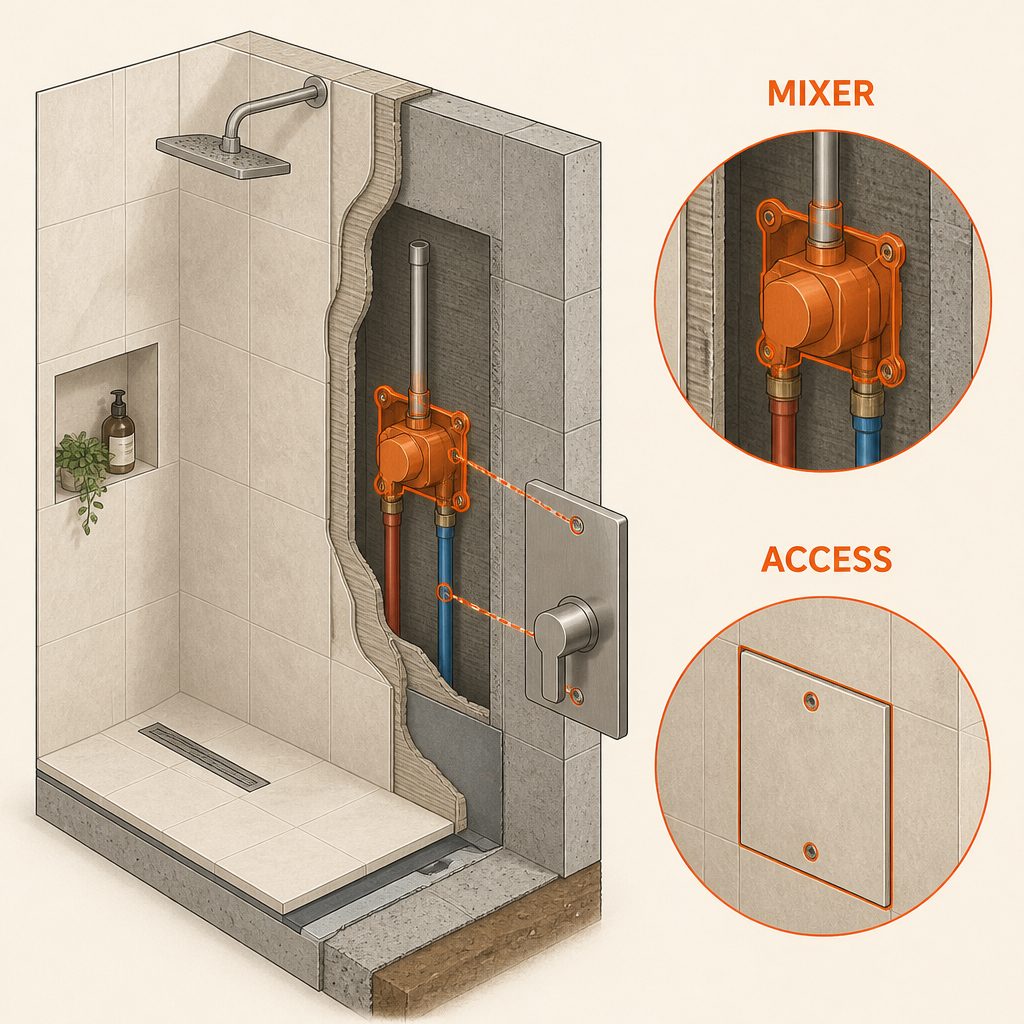
Then:
waterproofing.
Tile.
Finish.
Once everything closes, replacing the hidden component can become much more invasive.
So concealed components deserve serious attention.
10 FINISHES
Finishes
Chrome.
What changes beyond the visible finish?
The construction, coordination, maintenance and use still matter.
Chrome.
Black.
Brushed metal.
Gold-tone.
Other specialised finishes.
These can transform the appearance of the bathroom.
But specialised finishes may have different:
- cleaning requirements;
- replacement availability;
- scratch visibility;
- maintenance expectations.
So choose them because you want the appearance enough to live with the maintenance.
11 PRESSURE & THE RAIN SHOWER
Pressure & The Rain Shower
This is where Lesson 3.6 connects directly.
Imagine buying a beautiful large rain shower.
Turn it on.
Weak flow.
The fitting is not defective.
The system simply cannot supply its intended demand.
Before choosing demanding fittings, know:
pressure
flow
hot-water capacity
12 BATHROOM SYSTEM
Bathroom System
A bathroom connects almost everything we have learned.
Water arrives.
Water is heated.
Fixtures need usable flow.
Water must stay where it belongs.
Water must leave.
Lights, exhaust and sometimes geyser.
The finished surfaces.
Moisture has to escape.
The bathroom is not a collection of sanitary fixtures.
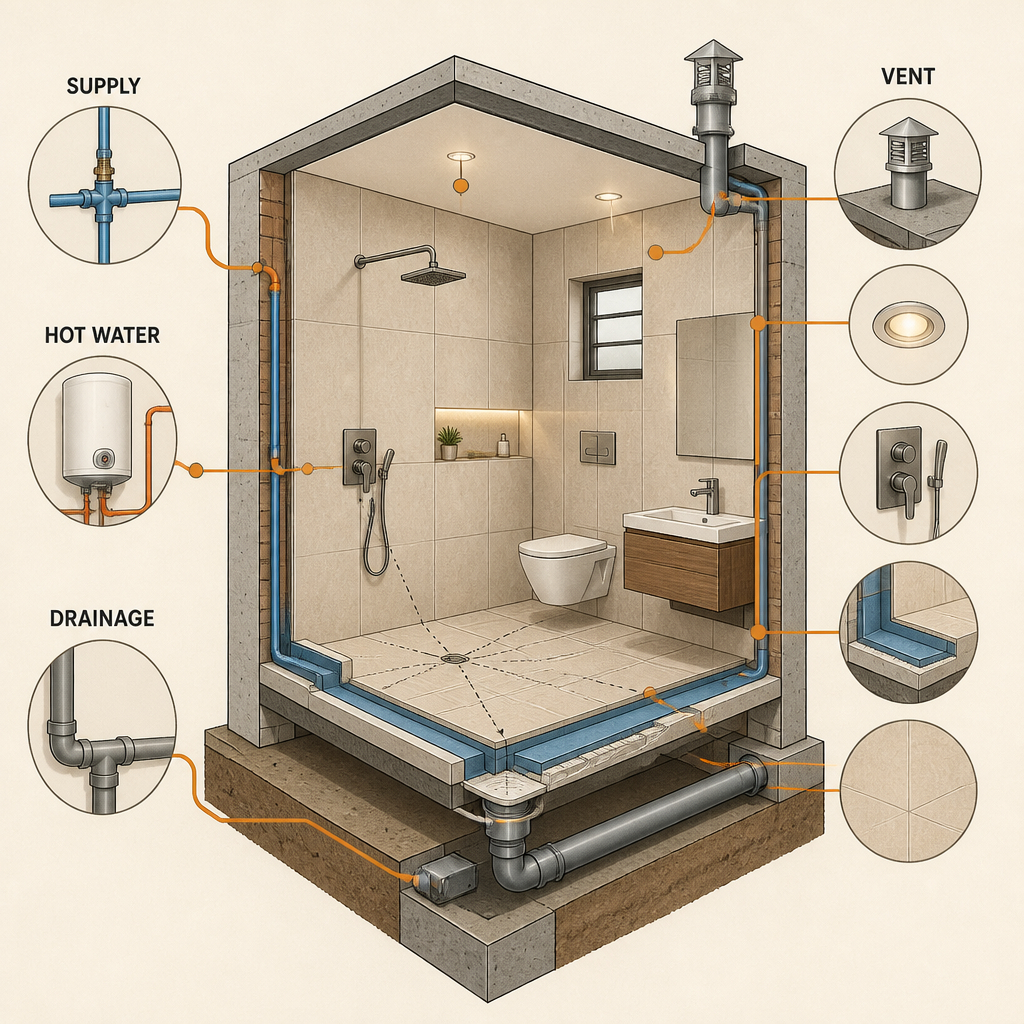
It is a small building system.
13 CRAFT
Craft
Function
Fit
Coordination
Maintenance
Before tiles close everything:
Do not improvise later.
A surprisingly common conflict.
Correct model and depth.
Before finishes.
Before the expensive surface arrives.
Water needs somewhere to go.
Valves and hidden components should remain manageable.
14 CHECK YOUR UNDERSTANDING
Luxury is not the number of fixtures.
The room already feels tight with WC, basin and shower. What is more likely to improve it?
Add a bathtub
Keep fewer fixtures comfortable
Luxury is how comfortably the room works.
Apply the idea
Protect the two fundamentals before adding fixtures.
Complete the decision to finish this scene.
Choose exactly 2.