Lesson 3.8
Wet-Area Waterproofing
01 start with coverage there are three common ways people think about waterproofing coverage.
Drainage gets water away.
The visible finish is only the final layer of the decision.
01 Start With Coverage
There are three common ways people think about waterproofing coverage.
BATHROOMS ONLY
Protect the primary wet areas inside the house.
BATHROOMS + BALCONIES
Extend protection to areas directly exposed to rain and drainage.
BATHROOMS + BALCONIES + TERRACE
Include the major horizontal wet and weather-exposed surfaces.
This can look like:
basic → better → best
But that is too simple.
The right amount of waterproofing depends on the building.
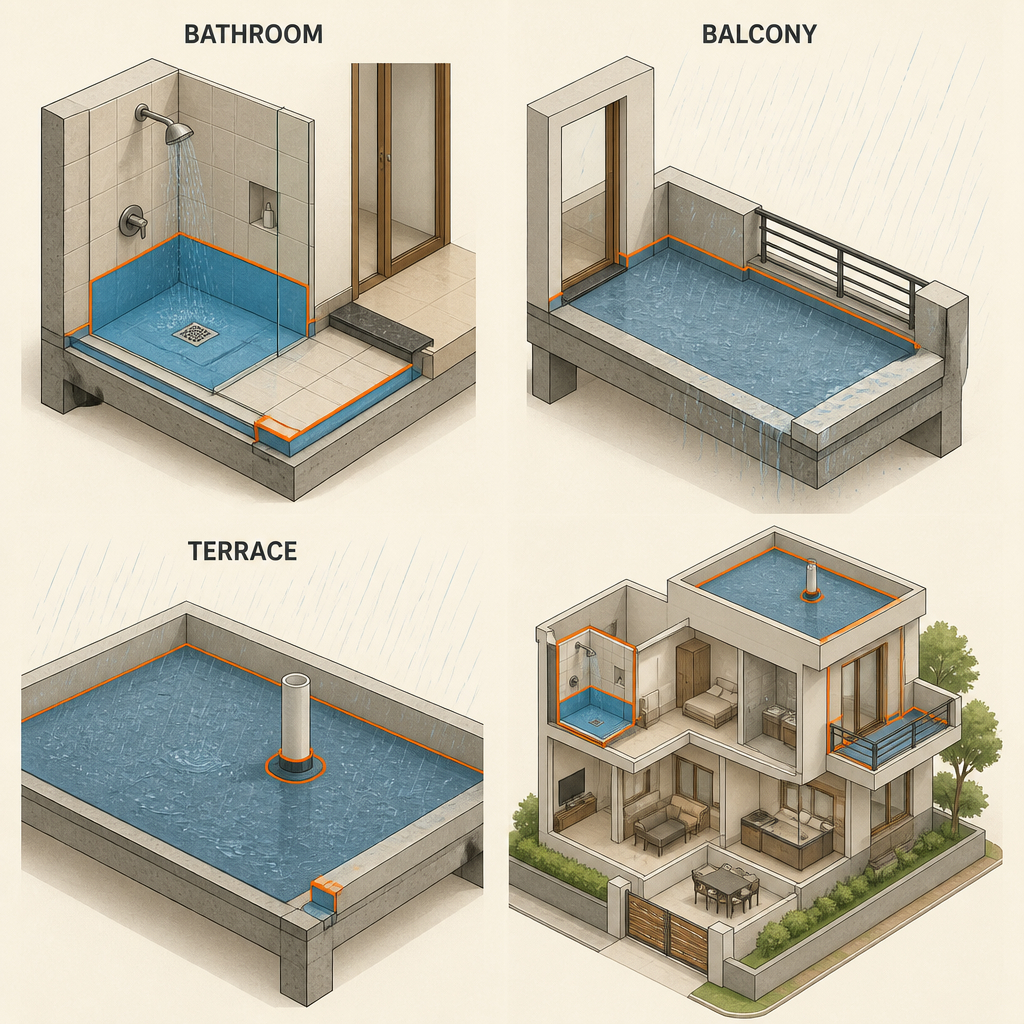
Waterproof the risk.
Do not waterproof by label.
02 Bathroom Waterproofing
The bathroom regularly puts water directly onto the building.
The main vulnerable zones include:
shower floor
wall-floor junction
drain
pipe penetrations
wet walls
The objective is not merely to stop water appearing in the room below.
It is to keep water from entering the construction layers in the first place.
03 Balconies
Rain creates a different problem.
Balconies are exposed to:
- rain
- temperature changes
- external edges
- drains
- thresholds.
A balcony also sits next to the interior floor.
That creates one very important detail:
Where does outside water stop before it reaches inside?
Slope.
Drain position.
Door threshold.
Waterproofing upturn.
All matter together.
A beautiful balcony tile cannot compensate for water sloping toward the bedroom.
04 Terraces
The roof is one enormous wet area.
A terrace can receive:
direct sun
heavy rain
temperature movement
and sometimes temporarily ponded water if drainage is poor.
So terrace waterproofing cannot be separated from:
slope
drainage
outlets
parapet junctions
pipe penetrations
A waterproof terrace still needs to drain.
Keeping water sitting permanently on top of a waterproof layer is not the objective.
NOW THE SYSTEM TYPE
05 Basic Chemical / Cementitious Systems
These are often applied as coatings over prepared surfaces.
They can provide economical protection in suitable locations.
What matters
- correct substrate
- adequate coverage
- continuity
- corners
- curing/application requirements
- protection before finishes.
They can be very effective where the exposure and specification suit them.
06 Advanced / Flexible Systems
Some waterproofing systems are designed with greater ability to accommodate small movements or provide more robust protection.
That can be useful where:
- exposure is greater
- movement is expected
- geometry is more complex
- consequences of leakage are higher.
But:
more expensive chemical does not replace detailing.
A flexible coating still has to meet:
drain
pipe
wall
threshold
correctly.
07 Membrane Systems
Create a dedicated waterproof layer.
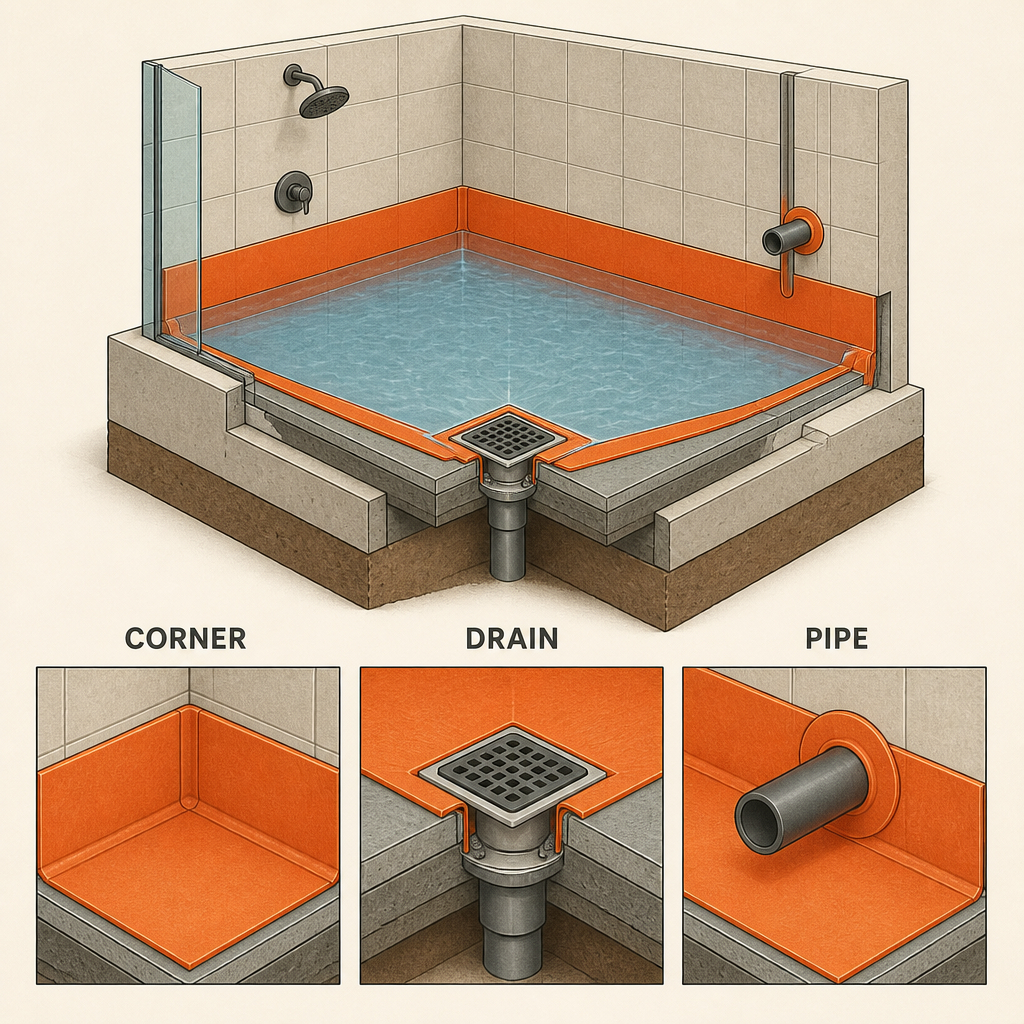
A membrane can form a more distinct physical barrier.
These systems can be useful in demanding applications.
But membranes introduce details of their own:
laps
corners
terminations
penetrations
protection layers
Again:
The centre of the membrane may be perfect.
The failure may happen at one pipe.
Waterproofing fails locally.
Water damage spreads globally.
08 The Coverage Illusion
“We waterproofed the terrace, so the terrace cannot leak.”
Not enough information.
Was the slope correct?
Were outlets detailed?
Were parapets treated correctly?
Was the layer damaged by later work?
What happened around pipes?
Was the system tested before covering?
Is the entire water path resolved?
09 Test Before Covering
This is one of the most important principles in wet-area construction.
Once tiles are laid, the waterproof layer disappears.
So wherever applicable, testing and inspection should happen before expensive finishes hide the work .
Visual sequence
Waterproof
↓
Test
↓
Correct defects
↓
Protect
↓
Tile / finish
Not:
Waterproof → immediately hide it
10 Craft
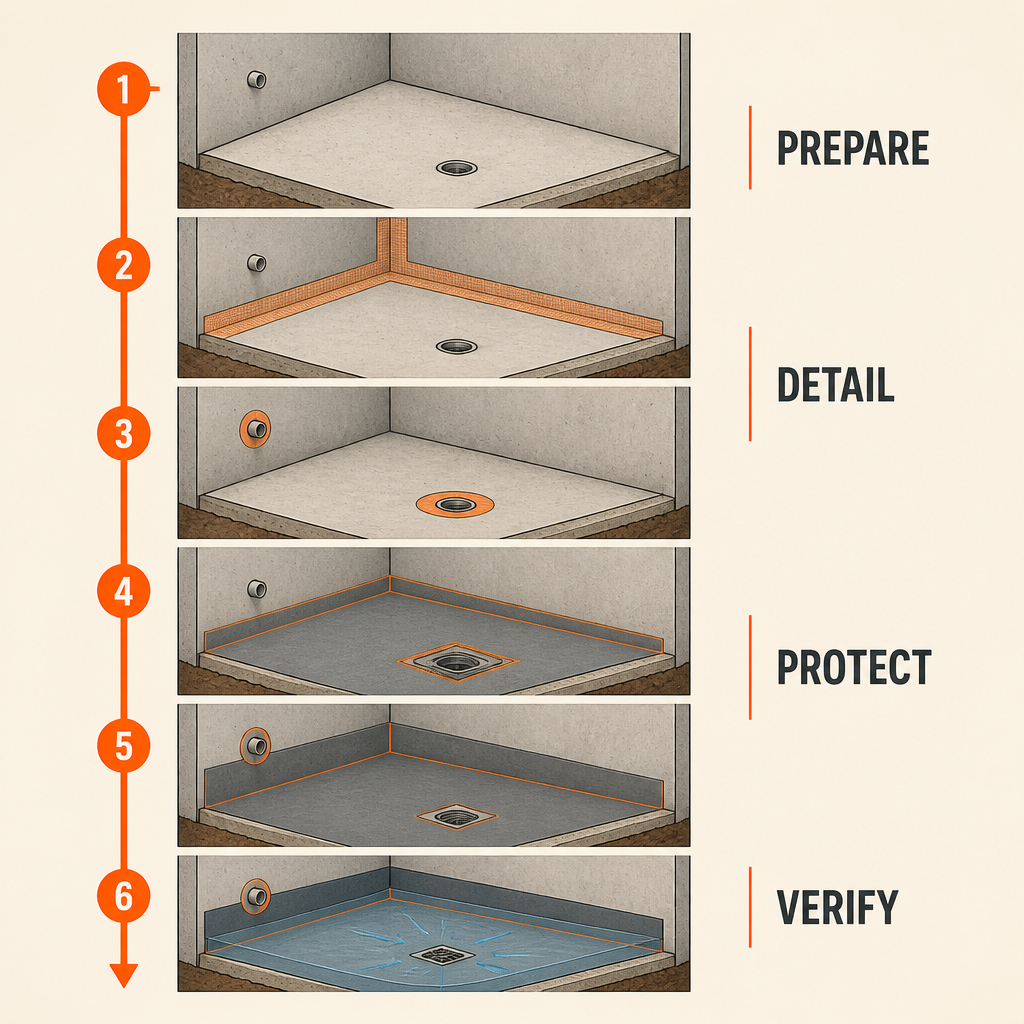
PREPARE THE BASE
Dust, loose material and bad surfaces matter.
DETAIL CORNERS
Floor-wall junctions are critical.
DETAIL PIPES
Every penetration interrupts the surface.
RESOLVE DRAINS
Waterproofing should integrate with drainage.
PROTECT THE LAYER
Later trades should not puncture it casually.
VERIFY SLOPE
Water needs to reach the outlet.
11 Check Your Understanding
What should happen before the waterproofing disappears?
Select the construction stages in the correct order.
Tile / finish
Test
Protect
Waterproof
Correct defects
Drainage gets water away.
The visible finish only works when the construction beneath it has been resolved.
Apply the idea
Match the wet zone to the protection concern.
Complete the decision to finish this scene.